
Supreme Court Tariff Ruling Could Trigger Market Volatility as Traders Brace for IEEPA Decision
One of the key market focus points right now revolves around the U.S. Supreme Court’s review of the Trump administration’s use of the International Emergency Economic Powers Act (IEEPA) to impose tariffs under claims of national emergency.
After hearing oral arguments from Trump’s legal team and those against the use of IEEPA tariff and the questions posed by the justices within the court, traders now see an increased probability that the Supreme Court will rule against Trump’s use of IEEPA tariffs—either striking them down entirely or in part. Prediction platform Polymarket currently assigns a 75% probability to a partial or full reversal.
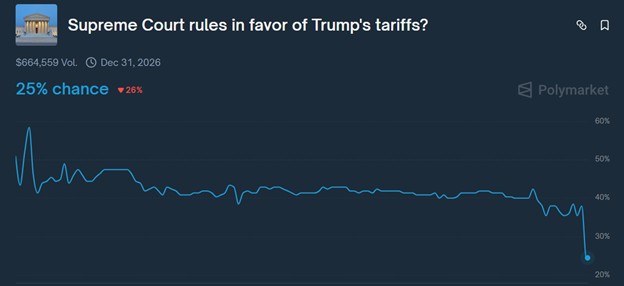
There are several plausible rulings the Court could deliver:
This would maintain the status quo and cement executive authority to use IEEPA for trade policy. Markets would likely interpret this as continuity and stability.
Partial or full invalidation (most likely scenario):
The Court could strike down all or part of the tariffs, which would have both short-term and potentially far-reaching legal, economic, and market consequences.
Remand to the International Court of Trade:
The justices could send the case back with guidance for reinterpretation, effectively delaying a final decision.
Jurisdictional dismissal:
The Court could rule that it should never have taken the case, though this outcome is considered low probability.
If the Supreme Court invalidates the IEEPA tariffs, U.S. businesses that paid those levies will file claims for refunds to the government seeking partial or full refunds. The claims process is expected to be slow, complex, and businesses will need to follow a protocol which is obviously still not known to quantify those claims.
Section 338, which permits tariffs of up to 50% on nations discriminating against U.S. exports.
The potential removal of IEEPA tariffs would temporarily strip the Trump administration of a key negotiating tool used to pressure major trading partners such as China and Canada. Markets may respond with sharp moves across currencies, equities, and commodities, as investors reassess the balance of trade risks.
The Supreme Court’s IEEPA tariff ruling could represent a short-term blow to Trump’s economic plans – but while it could be seen as one of more consequential policy events into 2026, there are offsets that suggest the fallout could be well contained. We just don’t know, and the uncertainty and lack of visibility to price risk around an outcome could result in higher volatility.
Disclaimer:
The material provided here has not been prepared in accordance with legal requirements designed to promote the independence of investment research and as such is considered to be a marketing communication. Whilst it is not subject to any prohibition on dealing ahead of the dissemination of investment research we will not seek to take any advantage before providing it to our clients. Pepperstone doesn't represent that the material provided here is accurate, current or complete, and therefore shouldn't be relied upon as such. The information, whether from a third party or not, isn't to be considered as a recommendation; or an offer to buy or sell; or the solicitation of an offer to buy or sell any security, financial product or instrument; or to participate in any particular trading strategy. It does not take into account readers' financial situation or investment objectives. We advise any readers of this content to seek their own advice. Without the approval of Pepperstone, reproduction or redistribution of this information isn't permitted.
Publication date: